FREE STANDARD SHIPPING ON ALL BOXES

Last-Minute Gift Ideas That Still Feel Personal
There is a specific kind of stress that arrives when you realise a significant occasion is closer than you thought. It might be a birthday you marked in your calendar and then forgot to act on. A work anniversary that crept up during a busy week. A housewarming you said yes to months ago and only just remembered is this Saturday. The occasion is real, the relationship matters, and you are now operating with very little time. The instinct in this situation is to reach for whatever is fastest — a gift card, a bunch of flowers from the service station, something ordered in a panic that arrives looking exactly like something ordered in a panic. These solutions technically solve the problem of having nothing to give. They rarely solve the problem of wanting to give something that actually means something. The good news is that last-minute and thoughtless are not the same thing. With the right approach, it is entirely possible to give a gift that feels considered and personal even when the timeline is tight.
6/23/20263 min read
The gift card problem
Gift cards have become the default last-minute solution, and it is easy to understand why. They are instant, they are flexible, and they remove the risk of getting the wrong thing. But they also communicate, unmistakably, that the decision was made at the last moment with the recipient's preferences as a secondary consideration.
This is not always fatal. Between close friends who understand each other's lives, a gift card with a specific note can work perfectly well. But for a colleague, a client, a family member you see less often, or anyone for whom you want the gift to reflect genuine thought — a gift card tends to undersell the relationship.
The alternative is not necessarily more time. It is more intention.
What actually makes a gift feel personal
The assumption most people make is that a personal gift requires extensive planning — knowing someone's exact preferences, sourcing something bespoke, allowing weeks for delivery. In reality, what makes a gift feel personal has less to do with how long it took to organise and more to do with the care visible in the result.
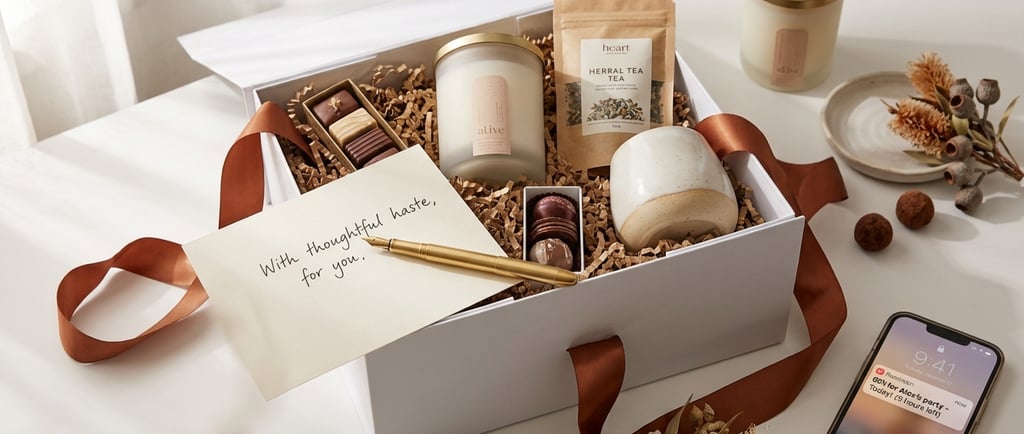
A box of products chosen around a specific occasion — a new home, a difficult week, a milestone birthday — communicates thought even when it was assembled quickly. The occasion itself provides the framework. The products fill it. The card carries the message that ties everything together.
This is why a well-curated gift box can function as a last-minute gift without feeling like one. The curation does the work that time would otherwise do. A recipient who opens a beautifully presented box of Australian artisan products does not experience it as hurried. They experience it as chosen.
The card matters more than you think
When time is short, the temptation is to focus entirely on the physical gift and treat the card as an afterthought. This is worth resisting. In many cases, a thoughtful card accompanying a simple gift will create a stronger impression than an expensive gift with a generic message.
A card that references something specific — the occasion, a shared memory, a detail about the person's life right now — transforms the experience of receiving a gift. It is the difference between feeling that someone sent you something and feeling that someone thought about you. The products in the box provide the experience. The card explains why.
Even a few lines written with genuine attention will land harder than a lengthy message that could have been sent to anyone.
Made-to-order does not mean slow
One of the misconceptions about premium gift boxes is that they require significant lead time — and for some, particularly those involving handcrafted or made-to-order components, that is true. But the principle of thoughtful curation does not require weeks of preparation.
Knowing what you are looking for, having a clear sense of the occasion and the person, and choosing products with genuine care can happen quickly when you know where to look. The difference between a last-minute gift that feels personal and one that does not is rarely the amount of time spent. It is the quality of the attention brought to the decision.
For occasions where lead time genuinely is short, the honest approach is to communicate that directly — to send what is available beautifully, accompany it with a card that acknowledges the moment, and allow the thought behind it to speak for itself. Most people are far more moved by evidence of genuine care than by elaborate presentation.
The occasions most worth getting right at the last minute
Not every last-minute gift carries equal weight. A spontaneous thank-you for a small favour is different from a corporate client's significant milestone you nearly missed. It is worth spending a moment identifying which category you are in before deciding how much effort the situation requires.
For the occasions that genuinely matter — a long-standing client relationship, a family member's significant birthday, a colleague leaving after years of working together — the last-minute constraint is worth working around rather than surrendering to. These are the moments people remember, and what they remember includes whether or not someone made the effort.
For smaller gestures, a simpler approach is entirely appropriate. A single beautifully chosen product, a handwritten note, something that acknowledges the moment without overcomplicating it. The scale of the gift should reflect the scale of the occasion, not the amount of time available to organise it.
Last-minute gifting does not have to mean settling. It means being clearer, faster, and more intentional than usual. The people worth giving to are worth that effort, even on a short timeline.
Modern Gift Co
For the Moments That Matter
© 2026 Modern Gift Co. All rights reserved.
FAQ

ABN 40 313 203 612