FREE STANDARD SHIPPING ON ALL BOXES
Employee Appreciation Gift Ideas for Australian Businesses
There is a particular kind of professional disappointment that arrives when you have worked hard, contributed meaningfully, and the acknowledgment you receive is a gift card to a retailer you rarely visit or a hamper filled with products nobody specifically chose for you. It is not that the gesture was unkind. It is that it communicated, clearly and unintentionally, that the effort required to choose something genuinely personal was not considered worth making. Most Australian businesses genuinely want their people to feel valued. The gap is rarely one of intention. It is one of approach — a default toward whatever is fastest and most defensible rather than whatever would actually create the impression of genuine appreciation. The result is employee gifting that fulfils an obligation without achieving its purpose.
7/9/20264 min read
Why employee appreciation matters more than most businesses realise
The relationship between feeling genuinely valued and professional performance is well established. Employees who feel recognised and appreciated are more engaged, more productive, and significantly less likely to leave. In an Australian labour market where replacing a skilled employee can cost a business anywhere from fifty to two hundred percent of that person's annual salary, the economics of genuine appreciation are compelling.
What is less often examined is the specific role that gifts play within that broader culture of recognition. A salary is an expectation. A bonus is a transaction. A gift — something chosen with thought and given without contractual obligation — occupies a different category entirely. It communicates care in a register that formal remuneration cannot access. When it is done well, it creates a feeling that is qualitatively different from any other form of professional acknowledgment.
When it is done badly, it creates a feeling too. Just not the intended one.
The occasions most worth getting right
Employee gifting covers a wide range of moments, and they are not all equal in their emotional significance. Understanding which occasions carry the most weight helps businesses direct their attention and investment toward the gestures that will create the strongest return.
Work anniversaries are among the most consistently undervalued. A five-year anniversary, a ten-year anniversary, a twenty-year anniversary — these are milestones that represent genuine commitment from an employee who had, at every point, the option to leave and chose not to. Acknowledging this with something genuinely considered says something important about how the organisation values loyalty. Acknowledging it with a generic gift card says something else entirely.
Onboarding is the other moment that most businesses underestimate. The first days in a new role are formative in ways that are difficult to overstate. A welcome gift that arrives beautifully presented, filled with quality Australian products chosen to create a warm first impression, communicates before a single meeting has taken place that this is an organisation that pays attention to people. It sets a tone that the new employee will carry through their early weeks — and that tone shapes everything that follows.
Significant personal milestones — a new baby, a marriage, a major personal achievement — are also worth acknowledging in professional contexts when the relationship warrants it. A business that notices and marks these moments communicates that it sees its people as whole human beings rather than productive units. That perception, once established, is extraordinarily difficult for a competitor to overcome.
The branded merchandise problem
The instinct to put a company logo on employee gifts is understandable but worth resisting. Branded merchandise communicates, however unintentionally, that the gift is partly a marketing exercise. It asks the recipient to become a walking advertisement for the organisation in exchange for the gesture of appreciation. Most employees will accept this gracefully and feel slightly less appreciated than they would have otherwise.
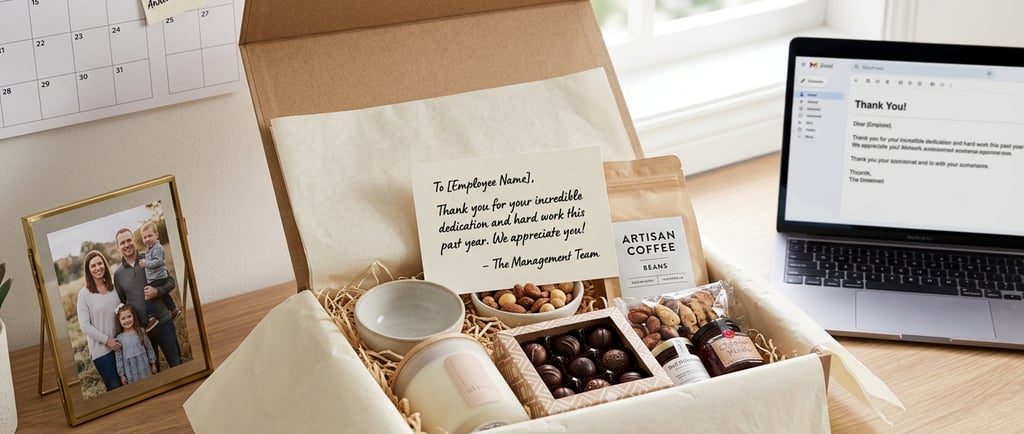
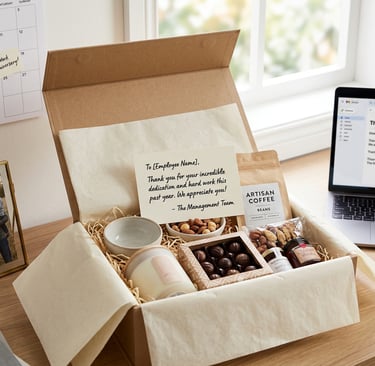
The more effective approach is to keep the products themselves entirely free of branding and let a thoughtfully worded card carry the company's voice. A beautifully curated box of Australian artisan products, accompanied by a personal note from a manager or business leader that references something specific about the employee's contribution, will create a far stronger impression than the same products with a logo printed on them.
The restraint is part of the message. It says: this gift is for you, not for us.
What genuine appreciation actually looks like
The gifts that employees remember and talk about share certain qualities. They are specific rather than generic — chosen with some knowledge of the person, or at minimum with genuine care for the occasion. They include at least one element that feels like a small luxury — something the recipient would consider excessive to buy for themselves but is genuinely delighted to receive. And they arrive accompanied by words that make clear why the gift was given and what specifically is being appreciated.
Australian artisan products work particularly well in this context because they introduce employees to something genuinely excellent that they may never have encountered on their own. A hand-poured soy candle from a small Sydney maker, a collection of small-batch chocolates from a regional producer, a ceramic piece made by an independent artisan — these products carry a quality and a story that mass-produced alternatives cannot replicate. They communicate that the business sought out something genuinely excellent rather than defaulting to whatever was easiest to source.
For remote or distributed teams, a gift box sent directly to an employee's home carries additional weight. It arrives in their personal space, at a moment when they are not performing their professional role, and it creates an experience that is entirely their own. The physical distance that remote work creates between employer and employee is partly bridged by a gesture that crosses it.
Gifting at scale without losing the personal touch
For businesses with large teams, the logistics of employee gifting can feel prohibitive. Gifting fifty employees individually requires coordination, budget management, and a level of personalisation that seems difficult to maintain at scale.
The solution is not to abandon personalisation but to build it into the process efficiently. A consistent product selection that represents genuine quality across the whole team, combined with individual cards that carry a personal message from each employee's direct manager, achieves the right balance. Every recipient receives something excellent. Every recipient also receives something that acknowledges them specifically.
Bulk pricing makes this more accessible than most businesses expect. The per-unit cost of a properly curated gift box reduces meaningfully at volume, which means the investment per employee at scale can be significantly lower than the retail price of individual boxes suggests.
Employee appreciation that actually works is not complicated. It requires genuine thought about the people being recognised, restraint with branding, attention to the moments that carry real emotional weight, and a commitment to quality that reflects how much the organisation actually values its people.
The businesses that get this right do not think of employee gifting as an HR line item. They think of it as one of the clearest expressions of their culture — a way of showing, in tangible form, what they believe their people are worth.
Modern Gift Co creates made-to-order corporate and employee gift boxes featuring Australian artisan products, with bulk pricing available from ten boxes. All orders are delivered across Australia with express post. Enquire about corporate and bulk gifting or shop individual gift boxes.
Modern Gift Co
For the Moments That Matter
© 2026 Modern Gift Co. All rights reserved.
FAQ
ABN 40 313 203 612