FREE STANDARD SHIPPING ON ALL BOXES
Best End-of-Year Corporate Gifts in Australia
The end of the year arrives the same way every time — faster than expected, with more to organise than anticipated, and a growing list of people who deserve to be acknowledged before the calendar turns. For Australian businesses, the period between November and January is one of the most significant gifting windows of the year. It is also the one most likely to be handled badly. The reasons are understandable. End-of-year gifting happens at a moment when everyone is already stretched. Budgets are being finalised, teams are distracted, and the path of least resistance — a case of wine, a hamper ordered in bulk from a catalogue, a gift card sent by email — presents itself as a reasonable solution to a time-sensitive problem. It is a reasonable solution. It is rarely a memorable one. The businesses that use end-of-year gifting to genuinely strengthen client and staff relationships are the ones that treat it as an intention rather than an obligation. The difference in outcome is significant. And the difference in effort is smaller than most people assume.
7/13/20265 min read
What end-of-year gifting is actually for
Before deciding what to give, it is worth being clear about what end-of-year gifting is meant to achieve. The answer varies by relationship and by business, but it almost always involves some combination of expressing genuine gratitude, reinforcing the value of the relationship, and creating an impression that carries into the new year.
A gift that achieves all three of these things does not need to be extravagant. It needs to be considered. It needs to arrive at the right moment, looking excellent, with a message that communicates something specific about why this relationship matters. Everything else — the products, the packaging, the price point — follows from that intention.
A gift that achieves none of these things can be very expensive indeed and still leave no impression at all. The wine that goes into a collection without being opened. The hamper that gets shared around the office and forgotten by afternoon. The gift card that expires unused. These are not gifts that failed because of their contents. They failed because the intention behind them was too thin to carry the gesture.
The timing question
End-of-year gifting in Australia operates across a longer window than most businesses plan for, and understanding the shape of that window helps avoid both the rush and the void.
The EOFY period in June and July is the first significant gifting moment — particularly relevant for industries organised around the financial year, including real estate, finance, and professional services. A client appreciation gift sent at EOFY acknowledges the year that has just passed and positions the business well for the year ahead. It also lands at a moment when most competitors are not gifting, which means it stands out rather than arriving in a crowd.
The Christmas and summer period — November through January — is the second and larger window. The challenge here is timing. Gifts sent in early to mid-December arrive when recipients are still present and engaged. Gifts that arrive in the final days before Christmas are often left at reception, opened distractedly, or not encountered until January. For corporate gifts intended to create a strong impression, earlier in December is almost always better than later.
For businesses that gift at both moments, the combination creates a consistent presence across the year that reinforces the relationship in a way no single gesture can achieve.
Why the standard corporate hamper no longer cuts through
The Australian corporate hamper has become so familiar as an end-of-year gift that it has largely ceased to communicate anything beyond obligation fulfilled. Recipients who have worked in professional environments for more than a few years have received enough crackers, shortbread, and bottled condiments to last a lifetime. The products are fine. The impression is negligible.
The shift away from standard hampers toward properly curated gift boxes is accelerating in 2026, driven partly by recipients who have started to notice the difference and partly by businesses that have started to notice that their gifting is not generating the referrals and loyalty they expected.
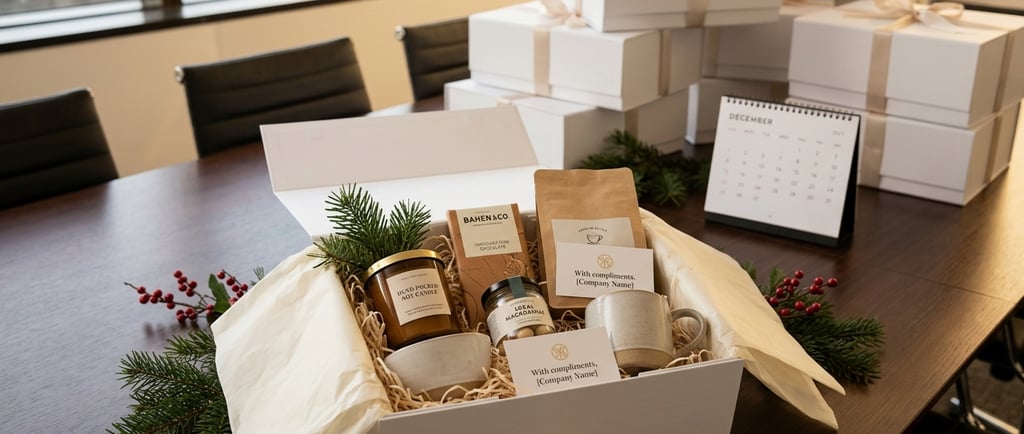
A properly curated gift box differs from a hamper in ways that are immediately legible on opening. The products are genuinely excellent rather than generically premium. The presentation is considered rather than convenient. The overall experience of receiving it communicates that someone made real choices rather than ticking boxes. That difference is felt by the recipient before they can articulate it — and it shapes how they think about the relationship going forward.
Australian-made as a differentiator
One of the clearest ways to distinguish an end-of-year corporate gift in the Australian market is to build it around locally made products. This approach has practical, aesthetic, and reputational advantages that generic alternatives cannot match.
Practically, Australian artisan products tend to be fresher, better packaged, and more distinctive than their mass-produced equivalents. Aesthetically, they reflect a coherence of craft and quality that makes the overall box feel intentional. And reputationally, a gift built around small Australian makers signals something about the values of the business that sent it — that it cares about quality, about provenance, and about supporting the local makers and producers who represent Australian craft at its best.
For clients who share these values — and in 2026, a growing proportion of Australian professionals do — a gift built around genuinely excellent local products creates a connection that goes beyond the commercial relationship. It says: we see the same things you see. We care about the same things you care about. That alignment is the foundation of the kind of loyalty that no competitor can easily disrupt.
The card is doing more work than you think
End-of-year gifting at corporate scale tends to produce cards that are warm in tone and entirely generic in content. Seasons greetings. Thank you for your continued support. We look forward to working with you in the new year. These messages are not wrong. They simply do not do very much.
A card that references something specific — a project completed together, a challenge navigated, a milestone reached, a detail about the client's year that demonstrates genuine attention — transforms the experience of receiving the gift. It provides the meaning that the products alone cannot carry. And in a bulk gifting program where every box contains the same products, the card is the only element that differentiates one recipient's experience from another's.
The investment required to personalise cards at scale is not as significant as it appears. A template that carries a consistent opening and closing with a single personalised paragraph in the middle can be adapted efficiently across a large recipient list. The result is a card that feels written for the individual while remaining manageable to produce at volume.
Planning for next year, starting now
The businesses that execute end-of-year gifting most effectively are the ones that do not begin planning in November. They begin in August or September, when there is time to think carefully about the recipient list, align on budget, brief a gifting partner, and build in the lead time that quality made-to-order gifting requires.
This is particularly important for businesses with large recipient lists or complex logistics — multiple offices, interstate clients, a mix of individual and bulk sends. The conversations that need to happen to execute a gifting program well take time, and time spent rushing those conversations tends to produce results that reflect the rush.
For businesses approaching this for the first time, or reconsidering their approach after years of standard hampers, the starting point is simpler than it seems. Identify the relationships most worth investing in. Decide what you want those people to feel when the gift arrives. Find a gifting partner whose product and approach reflects that intention. Everything else follows.
End-of-year corporate gifting done well is one of the highest-return investments a business can make in its client and staff relationships. Done badly, it fulfils an obligation and creates no lasting impression. The difference between the two is not budget. It is intention, timing, and the willingness to choose something that actually reflects how much those relationships are worth.
Modern Gift Co specialises in made-to-order corporate gift boxes featuring Australian artisan products, with bulk pricing available from ten boxes. For end-of-year gifting programs, we recommend beginning the conversation at least four to six weeks before your intended send date. Enquire about corporate and bulk gifting or shop individual gift boxes.
Modern Gift Co
For the Moments That Matter
© 2026 Modern Gift Co. All rights reserved.
FAQ
ABN 40 313 203 612